Global Entrepreneurship Education
From understanding the Silicon Valley startup ecosystem to hands-on execution with Agentic AI and 1:1 VC mentoring — a fully connected program.
Select Program Part
Click one of the 4 programs below to see its schedule and details.
Global Startup Program (Silicon Valley)
PART 1Objective: Build global startup capabilities through collaboration with Silicon Valley experts — experiencing global capabilities and preparing for startups step by step.
Format: Online startup education programs, offered in three lengths: 1-week, 4-week, and 3-month programs.
Instructors / Faculty
Silicon Valley ecosystem
Experts who explain Silicon Valley’s history and why global technology and investors gather there.
Entrepreneurship educators
AI specialists
Investment firms
Heads of Silicon Valley investment firms, explaining the investment process.
Career support for resume and interview preparation.
Sample Schedule: 1-Week Agentic AI Startup Online Program
Idea Discovery & Customer Validation
Deriving ideas with Agentic AI; problem–solution fit verification
Business Model & Market Fit
Agentic AI-based business model building and market-fit
VC Fundraising & AI Tools
Understanding the VC funding system (Thomas Toy); hands-on ChatGPT and Gemini use
AI Marketing & AI-Native Companies
Agentic AI marketing strategy; building Generative AI-based AI-native startups (Silicon Valley AI expert)
Online AI Course Proposal (1 month, 3 months)
PART 2G6 Global Partner.
Proposal: Open four online AI courses, focus on using AI for work and automation; major courses focus on developing AI applications and evaluating services. Learners choose by background and available time.
Structure: All courses run once a week, 2 hours per session, online. One month = 4 weeks; three months = 12 weeks. Each course recruits and runs independently — the 3-month courses do not require a 1-month course, and the first 4 weeks are not run as a shared common course.
Course Overview
Non-major, 1 month
Non-major, 3 months
Major, 1 month
Major, 3 months
| Track / Length | Course Name | Hours | Final Deliverable |
|---|---|---|---|
| Non-major, 1 month | Personal Productivity with Generative AI | 4 sessions / 8 hours | Report and presentation materials |
| Non-major, 3 months | AI for Work and Automation Projects | 12 sessions / 24 hours | AI work assistant or automation |
| Major, 1 month | Building AI Apps with LLM APIs | 4 sessions / 8 hours | Small AI app |
| Major, 3 months | Real-World AI Service Design, Development & Evaluation | 12 sessions / 24 hours | AI service and evaluation report |
Design Approach
One-month courses focus on quickly completing one concrete deliverable. Three-month courses connect foundational understanding, step-by-step practice, project implementation, and verification to build real usable ability. Beyond tool operation, they also cover accuracy of results, verifying sources, privacy protection, and responsible use. A standard session is 50 minutes of concept explanation and demo, 60 minutes of practice, and 10 minutes of feedback (adjusted on final presentation days).
Non-Major, 1 Month: Personal Productivity with Generative AI
Goal: Without coding experience, use AI to complete a full task — research, writing, and presentation — and review the results.
| Week | Topic | Content and Practice | Deliverable |
|---|---|---|---|
| Week 1 | How to Use AI and Ask Questions | Possibilities and limits of generative AI; prompt writing with goals, context, and output format; improving answers | Personal prompt set |
| Week 2 | Research and Report Writing | Searching, summarizing, and comparing sources; verifying sources and facts; writing emails and reports | Short research report |
| Week 3 | Data Interpretation and Presentation Materials | Simple table analysis, chart interpretation, presentation flow, and slide drafts | Presentation draft |
| Week 4 | Personal Project | Complete one’s own task; check accuracy, privacy, and copyright; present and receive feedback | Report and presentation materials |
Completion deliverables: A short report and presentation materials on one connected topic, plus a reusable prompt collection. Example projects: market research and presentation materials, educational materials, event planning proposals. Learning support: work-specific example materials and prompt templates; 1–2 hours/week of outside practice recommended; the personal task chosen in Week 1 is developed through Week 4.
Non-Major, 3 Months: AI for Work and Automation Projects
Goal: Learn AI from the basics, find application points in one’s own work, and build and verify a customized AI assistant or simple automation.
| Week | Topic | Content and Practice |
|---|---|---|
| Week 1 | Understanding AI and Finding Work Opportunities | AI principles and limits, use cases, finding AI application candidates in one’s own work |
| Week 2 | Work Design and Prompting | Task breakdown; designing input materials, instructions, output format, and review criteria |
| Week 3 | Research and Evidence Verification | Searching, summarizing, and comparing; verifying sources; judging errors and uncertainty |
| Week 4 | Document-Based AI Assistant | Q&A using regulations and manuals; showing sources and checking answers |
| Week 5 | Data Analysis and Decision-Making | Organizing survey and sales data, comparing indicators, creating, and interpreting charts |
| Week 6 | Document and Content Creation | Turning analysis into reports and presentations; audience-specific expression and visualization |
| Week 7 | Building a Customized AI Assistant | Choose education, administration, marketing, or planning; set roles, materials, and instructions |
| Week 8 | No-Code Automation Basics | Connecting input, AI processing, and result storage; human review and approval |
| Week 9 | AI Agents and Operations Management | Multi-step work, tool use, exception handling, privacy, permissions, and cost |
| Week 10 | Final Project Implementation | Finalize problem and success criteria; build the assistant or automation |
| Week 11 | User Testing and Improvement | Verify accuracy and convenience with real cases; measure time saved |
| Week 12 | Final Presentation and Adoption Plan | Demo; explain effects and limits; organize user guide and adoption plan |
Completion deliverables: An AI work assistant or automation flow, a user guide, and an effectiveness evaluation sheet. Example projects: administrative document assistant, class-material assistant, customer-inquiry draft assistant, survey-analysis automation.
Major, 1 Month: Building AI Apps with LLM APIs
Goal: Learners who know basic Python syntax and functions use LLM APIs to develop a small app with input, processing, output, and a screen.
| Week | Topic | Content and Practice | Deliverable |
|---|---|---|---|
| Week 1 | Starting LLM API Development | Development environment, API calls, message and context design, basic prompt practice | Python-based AI program |
| Week 2 | Structured Output and Error Handling | JSON output, input/output validation, exception handling, checking tokens, and cost | Information-extraction program |
| Week 3 | AI App Implementation | Connecting a user screen using an example structure; implementing a chosen feature such as summarization or information extraction | AI app prototype |
| Week 4 | Evaluation and Project Demo | Checking accuracy with test cases, improving prompts, documenting how to run the app, and presenting | AI app and source code |
Completion deliverables: A working AI app, source code, basic test results, and a run guide. Example projects: document summarizer, information extractor, writing-assistant tool. Prerequisites and support: Basic Python is required. Development-environment guidance and sample code are provided before the course; 2–3 hours/week of outside practice are recommended. To finish within 8 hours, learners focus on one core feature.
Major, 3 Months: Real-World AI Service Design, Development & Evaluation
Goal: Based on basic Python and programming experience, design a service using RAG and tool calling, evaluate its quality, and deploy it. RAG is a method that generates answers using document search results.
| Week | Topic | Content and Practice |
|---|---|---|
| Week 1 | AI Service Structure and Development Environment | Roles of model, data, search, tools, and screen; problem definition and environment setup |
| Week 2 | LLM APIs and Output Control | Prompt design, structured output, input validation, and exception handling |
| Week 3 | Document Data Pipeline | Document extraction, cleaning, and splitting; metadata design and data-quality checks |
| Week 4 | Embeddings and Search | Embedding principles, vector-search practice, comparison with keyword search |
| Week 5 | RAG Application Implementation | Connecting search results with the LLM; showing sources and managing unanswerable cases |
| Week 6 | Evaluation and Search-Quality Improvement | Building test sets; evaluating search and answers; comparing document splitting and search settings |
| Week 7 | Tool Calling and Workflows | Function calling, external data integration, state management, and human approval |
| Week 8 | Service Integration and Security | Connecting screen and back end; API keys and access permissions; responding to prompt injection |
| Week 9 | Deployment and Operations | Deployment practice; checking logs, errors, and usage; managing response time and cost |
| Week 10 | Final Project Implementation | Finalize requirements and evaluation criteria; develop and integrate core features |
| Week 11 | Integrated Testing and Optimization | Testing normal and edge inputs; failure analysis; improving quality, speed, and cost |
| Week 12 | Final Demo and Technical Review | Service demo; explaining evaluation results and limits; submitting code and technical documentation |
Completion deliverables: A working AI service, source code, evaluation report, and operations guide. Example projects: corporate document search service, paper-analysis assistant, customer-support AI service.
Operations and Evaluation
Classes and support
Live online classes as the default, with lecture materials, examples, and assignments via the LMS. Recommended outside practice: 1–2 hours/week (non-majors), 2–3 hours/week (majors). Teaching-assistant or technical support staffing is to be agreed based on enrollment size.
Grading
Practice and assignments 40%, final project 50%, participation 10%. Non-majors are assessed on usefulness, accuracy, and reusability, majors on functional completeness, evaluation evidence, and reproducibility.
Completion criteria (recommended)
Attendance of 75% or higher, final project submission, and a total score of 60 or higher, to be finalized per school rules.
Practice environment and responsible use
A personal laptop and internet access are the baseline. Non-majors are guided on AI tool accounts, majors on Python development and API environments. Public and synthetic data are used first, and personal or company confidential information must not be entered into practice tools. Who bears paid accounts and API costs, and usage limits, must be settled before the course starts.
Items to Agree on Before Opening
Course operation
Faculty and support
Costs
Completion and content
| Area | Items to Agree |
|---|---|
| Course operation | Responsible department, start date and class times, target learners, and capacity |
| Faculty and support | Faculty, practice support staff, online platform, and materials provision method |
| Costs | Tuition, instructor fees, content production costs, tool subscriptions, and API budget |
| Completion and content | Certificate issuer and wording, whether sessions are recorded, and content usage scope |
After course composition is finalized: recruitment notice, pre-learning diagnostic, and account/environment checks. After the course: review completion rates, deliverable quality, learner satisfaction, and utilization effects for the next cohort. This document is a proposal for consultation; operating conditions and budget are to be mutually agreed.
Silicon Valley Acceleration Online Course Proposal
PART 3Proposer: G6 Global Partner.
Content note: The proposal states that implementation matrices follow, illustrating student activities from ideation through customer discovery to the final Demo Day across four standard academic formats.
The following implementation matrices illustrate the progression of student activities from ideation through. Customer discovery to the final Demo Day across four standard academic formats.
Table A1: One-Week Intensive Sprint (Bootcamp Format)
Target Application: Orientation weeks, hackathons, and intensive introductory workshops
| Schedule | Core Objective | Operational Milestones & Student Activities |
|---|---|---|
| Day 1 | Team Matching & Behavioral Readiness | Interdisciplinary team matching via Rule of Thirds; game-based trust and psychological safety simulations; introduction to lean principles. |
| Day 2 | Problem Definition & Hypothesis Mapping | Selection of open problem or sponsor challenge brief; mapping foundational business model assumptions and risk matrices. |
| Day 3 | Customer Discovery Sprint | Field interview sprint; completing 15+ stakeholder interviews; structured evening debrief to determine pivot or persevere. |
| Day 4 | AI Prototyping (IUP) & Landing Pages | Rapid deployment of AI-generated digital mockups and landing pages; running initial micro-ad tests for live engagement tracking. |
| Day 5 | Demo Day & Pitch Presentation | Pitch narrative refinement; presentation of market validation findings and live prototypes to an expert mentor panel. |
Table A2: Three-Week Accelerator Format
Target Application: Summer terms, international student academies (e.g., EIA model), and short-term certificate programs
| Schedule | Core Objective | Operational Milestones & Student Activities |
|---|---|---|
| Week 1 | Mindset Foundations & Needfinding | Team formation and C-suite role locking; intensive mindset exercises; deep immersion into user problem spaces and early interview preparation. |
| Week 2 | Discovery & AI-Assisted Prototyping | Execution of 30+ field interviews; rapid creation of AI-assisted Initial Untested Products; launching digital landing page traction tests. |
| Week 3 | Unit Economics & Investor Showcase | Basic unit economic modeling (CAC vs. LTV); pricing experiments; investor storytelling workshops; final Demo Day showcase with external judges. |
Table A3: Ten-Week Academic Quarter Format
Target Application: Standard undergraduate or graduate 10-week academic quarter courses
| Schedule | Core Objective | Operational Milestones & Student Activities |
|---|---|---|
| Weeks 1–2 | Orientation & Mindset Conditioning | Curriculum overview; behavioral simulations to flatten communication hierarchies; problem brief unveiling and open ideation. |
| Weeks 3–4 | Team Architecture & Scoping | Rule of Thirds team formation; operational C-suite allocation; hypothesis mapping and interview protocol design. |
| Weeks 5–7 | Field Discovery & Rapid Prototyping | Conducting 30+ customer interviews; iterative AI prototype generation; launching live landing pages and micro-budget ad campaigns. |
| Weeks 8–9 | Unit Economics & Pitch Rehearsals | Financial modeling, pricing validation, and go-to-market channel selection; dry-run pitch rehearsals with guest mentors. |
| Week 10 | Final Demo Day & Academic Review | Formal Demo Day presentation to venture and corporate evaluators; submission of a comprehensive venture reflection report. |
Table A4: Fifteen-Week Full Semester Format
Target Application: Full semester academic courses, deep research commercialization, and interdisciplinary capstones
| Schedule | Core Objective | Operational Milestones & Student Activities |
|---|---|---|
| Weeks 1–3 | Foundational Pillars & Hierarchy Flattening | In-depth BMoE mindset games; trust-building exercises; cross-disciplinary team matching; challenge brief presentations. |
| Weeks 4–6 | Stakeholder Mapping & Hypothesis Design | Customer persona mapping; formal C-suite contract signing; crafting falsifiable business hypotheses and discovery questionnaires. |
| Weeks 7–10 | Discovery & Iterative Prototyping | Completion of 50+ verified customer interviews; rapid IUP prototyping using AI; running multi-variant digital acquisition experiments. |
| Weeks 11–13 | Unit Economics & IP Strategy | Unit economics calculations; pricing sensitivity testing; evaluating regulatory, channel, and intellectual property considerations. |
| Weeks 14–15 | Pitch Mastery & Executive Demo Day | Mentor review board sessions; storytelling and presentation rehearsals; final Demo Day showcase with active venture capital judges. |
Silicon Valley Demo Day Program
PART 4A global expansion, B2G public procurement, PoC marketing, and VC investment program for startups.
Program headquarters: Santa Clara, Silicon Valley. Key focus areas: B2B / B2G / PoC / VC investment.
Program Objectives: Four Core Objectives
B2G Public Procurement
Direct connections with key departments of the Napa, San Francisco, and Santa Clara city governments, building a public procurement foundation.
Chamber of Commerce Network
Building a B2B business development cooperation framework with the SF Chamber of Commerce, the French American Chamber of Commerce, and the Napa Chamber of Commerce.
VC IR Pitching
1:1 investment pitching with leading Menlo Park VCs, including Startup Capital Ventures and TGVP.
Academic & AI Seminars
UC Berkeley SCET entrepreneurship education and Pragmatic AI expert seminars, including an invited Agentic AI expert seminar.
Program Methodology: Three-Step Roadmap to Global Market Entry
| Step | Format | Content |
|---|---|---|
| Step 1 | Online Mentoring | 4 days of pre-entry strategy development, IR deck refinement, and focused coaching on U.S. market targeting |
| Step 2 | 1:1 PoC Online | Support for establishing PoCs through pre-matching with U.S. local buyers, distributors, and investment partners |
| Step 3 | On-Site Dispatch Program | Up to 6 days on site in Silicon Valley: meetings with city halls, VCs, universities, and global accelerators |
Day 1: SF Chamber of Commerce & Meetings
Arrival and orientation
After arriving at SFO Airport, local orientation in San Francisco and networking meetings.
French American Chamber of Commerce
Connections to a network of 250+ multinational companies and SMEs in California. Founded in 1978, it represents 250+ multinational companies and SMEs with large investments and business bases in California, with 6,000+ business contacts, and is a member of the French International Chamber of Commerce and Industry (CCIFI), with 120 chambers in 95 countries and 35,000+ participating companies.
SF Chamber of Commerce & YesSF
Connections to B2G projects on urban sustainability and downtown revitalization.
Welcome dinner networking
Strategy meeting with the advisory board of Korean American Chambers of Commerce USA.


Day 2: Napa Valley B2G & Economic Development
Napa City Hall (Napa City)
Napa Chamber of Commerce
Visit to Domaine Chandon
| Visiting Organization / Contact | Key Activities |
|---|---|
| Napa City Hall (Napa City) | Meeting with the Economic Development Director and exploration of B2G public project opportunities |
| Napa Chamber of Commerce | Building a B2B network with 900+ local member companies |
| Visit to Domaine Chandon | Exploring AgTech and local industry cooperation opportunities |


Day 3: UC Berkeley & Pragmatic AI
UC Berkeley SCET
Introduction to the Sutardja Center program and a 10-minute pitch session for selected startups.
Pragmatic AI Seminar
AI business application workshop and "Investor Readiness Model" training.
KIC Silicon Valley
Visit to the San Jose-based global innovation center under Korea’s Ministry of Science and ICT.


Day 4: Menlo Park VC 1:1 Pitching
Invited VC judging panel
Tailored feedback for each participating in startup and exploration of investment potential.
Day 5: SF Trade & Economic Development & Santa Clara B2G
SF City Hall International Trade Office Meeting (SF City Hall)
Discussion of public procurement opportunities for startup technologies with the city government, through a visit to San Francisco’s Office of Economic and Workforce Development (OEWD).
Santa Clara City Government Meeting (Santa Clara City Hall)
Meeting with City Manager and economic development staff to explore smart-city and local-government technology procurement opportunities.


Day 6: Plug and Play & StartX Visit
Plug and Play (Sunnyvale)
Meeting with Directors and open innovation connections with global companies.
StartX (Palo Alto)
On-site session with the Stanford University entrepreneur community and accelerator.
Silicon Valley final wrap-up
Final feedback from a Mountain View investment firm and preparation for return.


Core Capabilities: G6 Global Support Solutions
Mentors: G6 Global partners.
PoC Marketing
Angel & VC Investment Connections
Santa Clara Showroom
U.S. B2G Public Procurement
Global IP & Certification
Entrepreneurship Education
| Capability | Description |
|---|---|
| PoC Marketing | Tailored proof-of-concept (PoC) and pilot validation for U.S. commercial buyers |
| Angel & VC Investment Connections | Seed investment and direct network connections with top-tier Silicon Valley venture capital firms |
| Santa Clara Showroom | Year-round permanent product showroom for U.S. buyers and distributors |
| U.S. B2G Public Procurement | Public procurement vendor registration in California and with local governments, plus prime vendor mentoring |
| Global IP & Certification | U.S. patent portfolio building and FDA and UL certification consulting support |
| Entrepreneurship Education | 1 to 2-week executive immersion programs on site in Silicon Valley and Irvine |
Local Government Partnership: Lecture & Graduation
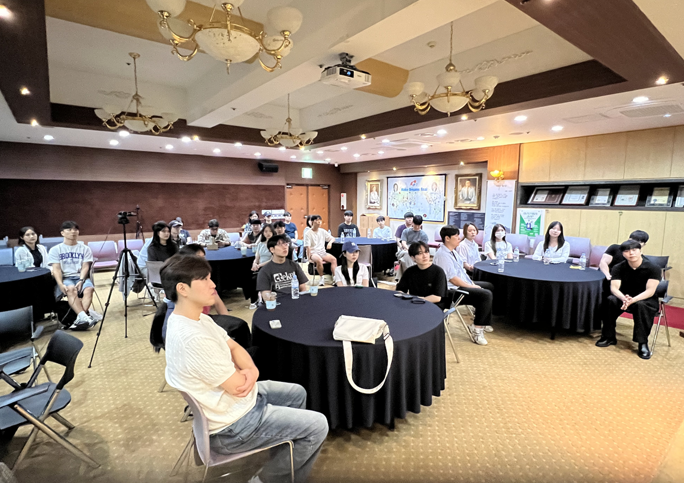
Cheonan City 'Blue Moon Dream' lecture case study (August 2025)
Lecture for Local University Students
Developed youth entrepreneurs in partnership with Cheonan City and Blue Moon Dream (Chairman Eun-su Moon).
Global IT Trend Lecture
Guest lecture by G6 Global CEO Henry Bang and the World OKTA Atlanta Chapter.
Panel Discussion & Graduation Ceremony
US market-entry Q&A, mentoring sessions, and awarding of global talent development certificates.

